
Mobile application penetration testing from Core Sentinel secures your iOS and Android apps the way a real attacker would test them — examining the app, the device it runs on, and the backend it talks to. Every test is performed manually by a senior, certified tester, aligned to the OWASP Mobile Application Security Verification Standard (MASVS). No junior bench. No scan-and-send.
Your app is on a device you don’t control
A web application runs on your servers. A mobile app runs on your customer’s phone — a device an attacker can fully control, jailbreak or root, decompile, and run under instrumentation. That changes everything. Code you assumed was private can be reverse-engineered. Data you assumed was safe can be read straight off the device. Security checks you built into the app can be bypassed at runtime.
Mobile apps are also a prime target precisely because they handle so much sensitive data — credentials, payment details, personal information, session tokens — and because so many are shipped with security treated as an afterthought. A Core Sentinel mobile penetration test finds those weaknesses before an attacker does.
Three layers — and most testing stops at one
A lot of what’s sold as “mobile penetration testing” is really just a quick poke at the app’s screens. A real assessment goes deeper, across all three layers where mobile risk actually lives.
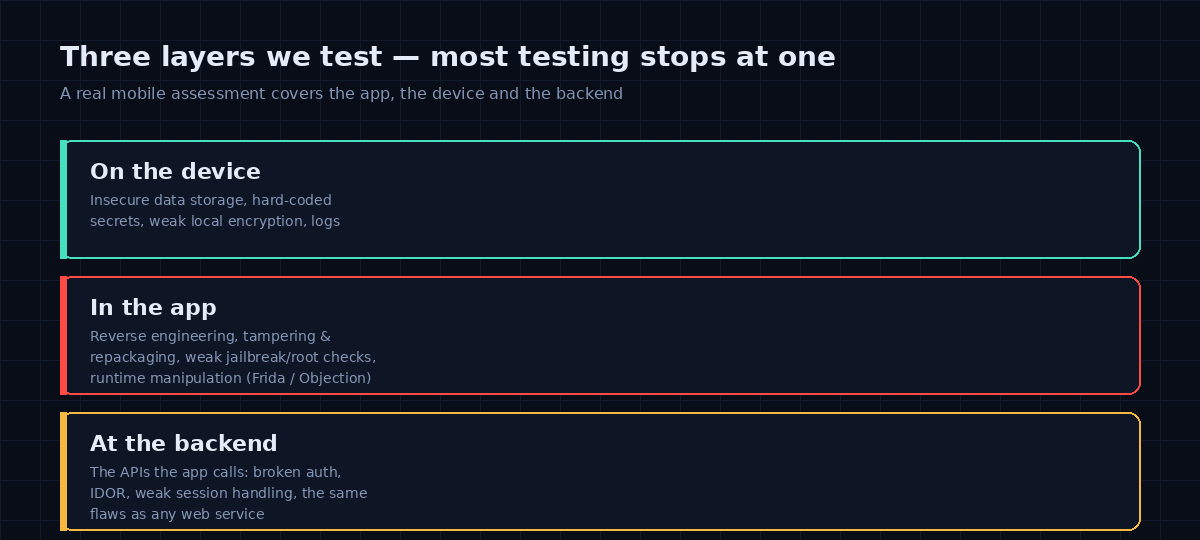
We test what’s stored on the device, how the app itself resists tampering and reverse engineering, and — crucially — the backend APIs the app depends on. That backend is where a great deal of serious risk hides, and it’s the layer cheaper mobile tests routinely skip.
Aligned to OWASP MASVS & MASTG
Our methodology follows the OWASP Mobile Application Security Verification Standard (MASVS) and the Mobile Application Security Testing Guide (MASTG) — the industry-standard frameworks trusted by platform providers, NIST and CREST. That gives you consistent, complete coverage of the standard mobile attack surface, and clean evidence of the controls tested. We combine both static analysis (decompiling and inspecting the app) and dynamic analysis (observing and manipulating it at runtime on real or virtualised devices).
What we test for
- Insecure data storage — sensitive data, tokens or credentials written to the device in plaintext, in logs, caches, or world-readable locations.
- Hard-coded secrets — API keys, credentials and encryption keys recoverable by decompiling the app.
- Weak cryptography — broken or misused encryption protecting local data and communications.
- Insecure communications — missing certificate pinning, weak TLS, and susceptibility to interception (man-in-the-middle).
- Reverse engineering & tampering — how easily the app can be decompiled, modified, repackaged and redistributed.
- Runtime manipulation — bypassing logic and security controls using instrumentation frameworks such as Frida and Objection.
- Weak jailbreak / root detection — checks that can be trivially defeated.
- Authentication & session handling — insecure session management, token storage and biometric/local-auth bypasses.
- Backend API security — broken access control, IDOR, weak authentication and the full range of web-service flaws in the APIs your app calls.
- Platform-specific issues — insecure use of iOS and Android platform features, inter-app communication, and exposed components.
Senior-only testing — the difference you receive
Mobile testing rewards experience more than almost any other discipline: bypassing a root check, hooking a function at runtime, or spotting that a “secure” token is actually recoverable from the keychain takes a skilled human, not a scanner. Every Core Sentinel engagement is performed by a senior, OSCE- and OSCP-certified tester. We manually validate every finding, build the real attack path, and rate severity on genuine business impact — not a tool’s default score.
What you receive
Our reports are written to be read — by your developers and your executives. Every finding includes a clear risk rating, a plain-English explanation of business impact, a working proof of concept, and a specific, prioritised remediation your team can act on immediately. Findings map to the OWASP MASVS so you have clean evidence of coverage for compliance and app-store assurance.
Once you’ve remediated, we re-test to confirm your risk is genuinely closed. And when we’re satisfied the risks are closed, we provide a signed letter of attestation — ready for your clients, auditors and compliance needs.
Who we work with
We test mobile apps for organisations across banking, finance, government, defence, health and education — sectors where a mobile app handles exactly the kind of data attackers want most. Whether you’re launching a new app, preparing for release, or assuring an app already in your customers’ hands, we tailor the engagement to your real risk.
Secure your app before your customers’ phones do the testing
Talk to a senior tester about your iOS or Android app — no sales engineers, no junior hand-off. Get a quote or call 1300 859 443.